Nonlinear photonic devices and materials
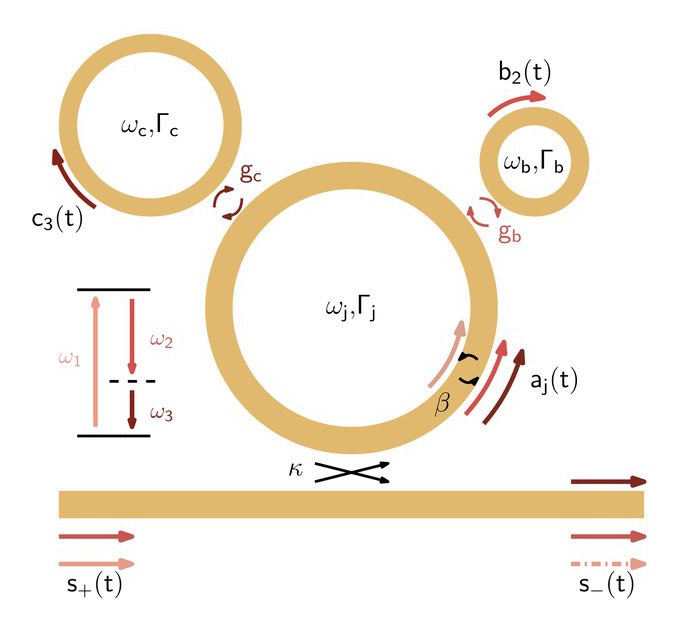
Nonlinear photonic devices are critical components of scalable quantum hardware as they enable precise control over the photonic degrees of freedom that are otherwise inaccessible. A key functionality is quantum frequency conversion wherein single photons are converted between different frequencies. This is especially important for spin-defect-based quantum networking as indistinguishability of emitted/scattered photons is a requirement for generating entanglement between spins. Moreover, long-range communication necessitates operation at telecom wavelengths where optical fiber losses are minimized; however, some of the most promising spin defects emit in the visible/near-infrared wavelength range.
Realizing quantum frequency conversion is extremely challenging because the underlying nonlinear interactions are weak and have to have high external efficiency. Consequently these interactions require high-quality-factor resonators and large pump powers, which can introduce noise and instability through parasitic processes like heating. The resulting narrow bandwidths also make frequency control a major challenge.
My research seeks to address these challenges by developing new nonlinear material platforms and techniques.